SOC 2 compliance is an self-dependent audit of your security controls against the AICPA Trust Services Criteria.
What
Is SOC 2 Compliance?
SOC 2 compliance indicates that a service
organization has been Self independently examined by a CPA firm and found to
meet the AICPA's Trust Services Criteria for protecting client data. In a Type
2 report, it informs your clients that your security measures are well-designed
and have been effective over time.
Full
title: “System and Organization
Controls (SOC) 2: Reporting on Controls at a Service Organization Relevant to
Security, Availability, Processing Integrity, Confidentiality, or Privacy.” It
is an attestation report issued under the AICPA’s attestation standards (AT-C
105 and AT-C 205), not a certificate.
SOC 2 compliance refers to having a SOC 2 examination report indicating that your controls meet the AICPA Trust Services Criteria. The AICPA developed the SOC 2 framework for technology and service organizations that store or process client data, such as SaaS suppliers, cloud providers, and managed service providers.
The examination and report are completed by a certified public accounting company. "Compliance" here does not imply official approval or certification. It indicates that your controls have been reviewed and an opinion has been provided by a Self-dependent auditor. Though SOC 2 is obliged by law, enterprise purchasers frequently demand it prior to signing. It is the US-origin equivalent of ISO's international certification and stands alongside [ISO 27001] as one of the two most sought-after security assurances.
Key Takeaways
- SOC 2 compliance is verified through a self-dependent CPA examination report, not by a certificate or a self-stated claim.
- This report is based on five Trust Services Categories: Security (which is always required), Availability, Processing Integrity, Confidentiality, and Privacy.
- A Type 1 report evaluates whether the controls are appropriately designed at a specific point in time.
- A Type 2 report goes further by assessing whether these controls operated effectively over a defined period, typically ranging from three to twelve months.
- Unlike SOC 1, the standards for SOC 2 are set by the AICPA, so organizations must align their controls with these established criteria rather than creating their own.
- The report is considered restricted-use and is shared with customers and potential clients under a non-disclosure agreement, rather than being made publicly available.
SOC 2
compliance is not a one-time accomplishment; reports are generally updated every
twelve months to ensure they remain current and relevant.
Where
It Sits
The Three Building Blocks of a SOC 2 Examination
SOC 2
is not just a single document. It consists of three layers that function in
tandem, and understanding them clarifies what the auditor truly assesses.
The Trust Services Criteria (TSC): What You Are Measured Against
The
AICPA's criteria cover Security, Availability, Processing Integrity,
Confidentiality, and Privacy. Every SOC 2 audit relies on these as its fixed
benchmarks. Security is required, while the remaining four are included
depending on your services and commitments to customers.
DC Section 200: How You Describe Your System
The
description criteria set forth by the AICPA. Management prepares a description
of the system, covering its boundaries, services, infrastructure, software,
people, data, and processes, and the auditor assesses it against DC 200.
AT-C 105 and AT-C 205: How the Auditor Examines
The
attestation standards that apply to the CPA's engagement: independence,
professional skepticism, and the requirements for reviewing management's
assertion regarding the system and its controls.
Taken
together: the criteria define what good looks like, the description defines
what your system actually is, and the attestation standards define how the
auditor evaluates both. SOC 1, in contrast, relies on AT-C 320 along with
control objectives set by management. See [What Is AT-C Section 320?] for that
comparison.
The
Five Categories
What the SOC 2 Trust Services Criteria Cover
Every
SOC 2 report includes the Security category, also called the Common
Criteria. The other four are optional.
Security (Required): Common Criteria CC1–CC9
Protects systems and data against unauthorised access and damage. The nine Common Criteria series are:
- CC1 Control environment (governance, ethics, board oversight)
- CC2 Communication and information
- CC3 Risk assessment
- CC4 Monitoring activities
- CC5 Control activities
- CC6 Logical and physical access controls
- CC7 System operations (detection, incident response)
- CC8 Change management
- CC9 Risk mitigation (including vendor and business-disruption risk)
Availability
Systems
are available for operation and use as committed: uptime, capacity, backup, and
disaster recovery.
Processing Integrity
System
processing is complete, valid, accurate, timely, and authorised. This suits
platforms that carry out transactions or calculations on behalf of customers.
Confidentiality
Information
designated as confidential is protected as committed: classification,
encryption, and secure disposal.
Privacy
personal
information is gathered, utilized, kept, shared, and discarded in accordance
with your privacy notice and commitments.
Guidance
on selecting categories: begin with Security. Only introduce a category
when customers or contracts require it, since each additional category expands
scope, evidence requirements, and expenses.
Report Types
SOC 2 Type 1 vs Type 2 Compliance
SOC 2 Type 1
Examines
whether the description is fairly presented and whether controls are suitably
designed at a single point in time. It is faster, often used as a first
milestone to unblock a sales deal.
SOC 2 Type 2
Examines
the same items, along with whether controls functioned effectively throughout
an observation period, and outlines the auditor's tests and their outcomes.
Most enterprise buyers request Type 2 since it demonstrates that controls work
in practice, rather than merely on paper.
| Type 1 | Type 2 | |
| Time covered | One date | Period (commonly 3–12 months) |
| Test design? | Yes | Yes |
| Test operation? | No | Yes |
| Buyer confidence | Moderate | High |
| Typical use | First report, quick sales unblock | Ongoing assurance |
A
common path is Type 1 first, then Type 2 on an annual cycle.
What the Auditor Evaluates
What Management’s System Description Must Contain
Under
DC 200, management’s description of the system should cover:
●
The
services provided and the system boundaries
●
The
principal service commitments and system requirements
●
The
infrastructure, software, people, procedures, and data in scope
●
How the
system handles significant events and conditions
●
The
control environment, risk assessment, information and communication,
monitoring, and control activities
●
The
controls designed to meet the applicable Trust Services Criteria
●
Complementary
user entity controls (CUECs) customers must implement
●
Subservice
organisations (for example, your cloud host) and whether they are carved out or
included, with any complementary subservice organisation controls (CSOCs)
●
For
Type 2, relevant changes to the system during the period
The
description does not have to list every procedural detail. It must not omit or
distort what customers need to assess your controls.
Process
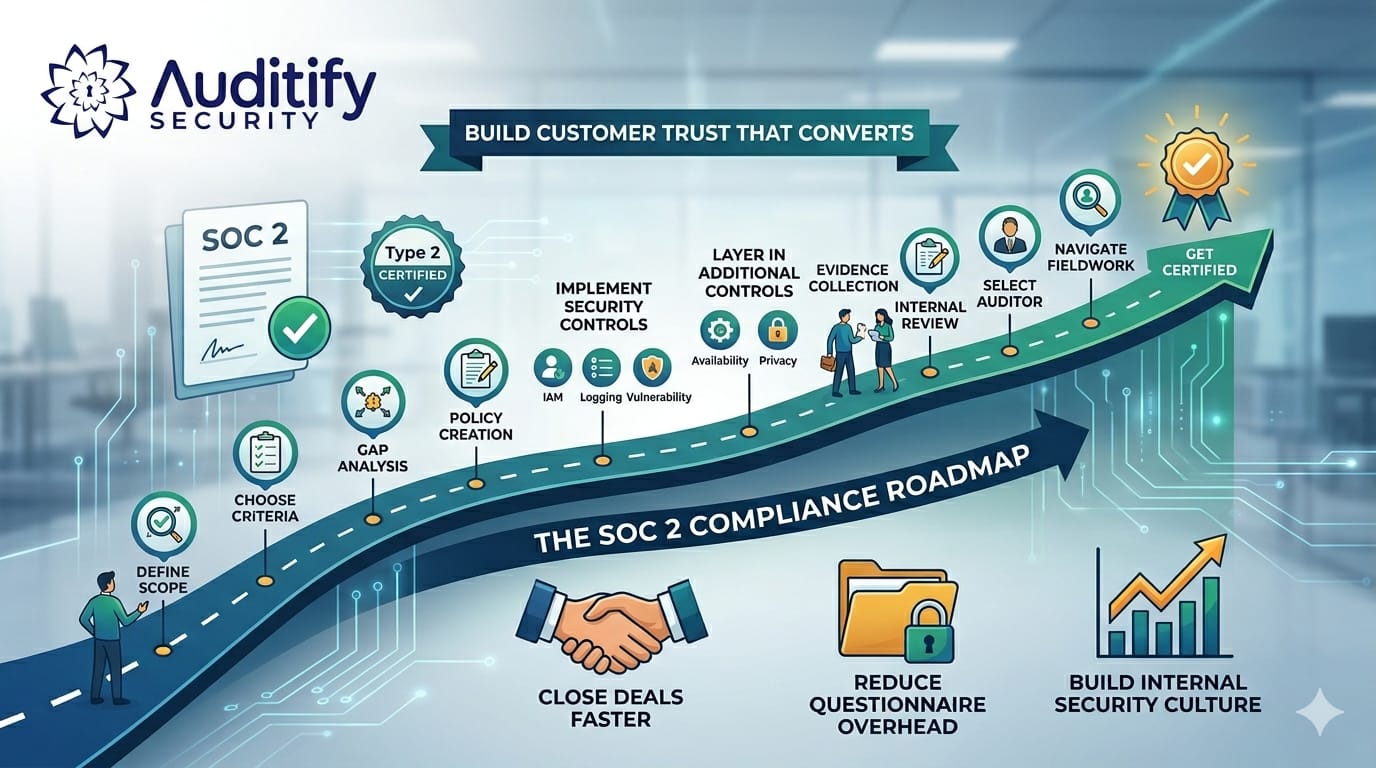
The SOC 2 Compliance Process: Step by Step
1. Define Scope and Categories
Choose
the systems, services, and Trust Services Categories in scope based on customer
demand and risk.
2. Run a Readiness (Gap) Assessment
Compare
your current controls against the criteria and list the gaps. This shows what
needs fixing before the audit.
3. Remediate and Implement Controls
Close
the gaps: write policies, enforce access controls, set up logging and
monitoring, formalise change management, vendor management, and incident
response.
4. Collect Evidence
Gather
proof that controls exist and operate, such as access reviews, tickets,
training records, and system configurations. Compliance automation tools can
help.
5. Complete the Audit Window (Type 2)
Controls
run throughout the observation period while the auditor samples evidence.
6. Auditor Fieldwork and Report
The CPA
firm tests controls, may raise exceptions, and issues the opinion and final SOC
2 report.
7. Maintain and Renew
Monitor
controls continuously and repeat the examination annually.
What the Opinion Means
Management Asserts, the Auditor Opinion
SOC 2
requires for a written management assertion: management declares that the
description is presented fairly, the controls were properly designed, and, for
Type 2, that they operated effectively. Without it the CPA is unable to issue
the report.
The auditor’s opinion can be:
- Unqualified: controls meet the criteria. This is the outcome most customers want.
- Qualified: one or more criteria were not met, with the reasons explained.
- Adverse or disclaimer: serious failures, or the auditor could not gather enough evidence.
Exceptions in testing do not automatically fail the audit. What matters is whether they are isolated and whether the opinion remains unqualified.
FAQ’s
SOC 2 Compliance: Common Questions
How SOC
2 actually works in practice.
What is SOC 2 compliance?
SOC 2 compliance means a service organisation has undergone
self-dependent CPA examination and received a report showing its controls meet
the AICPA Trust Services Criteria. It is an attestation, not a certification,
and it demonstrates how well you protect customer data.
Is SOC
2 mandatory?
No law requires it. It becomes mandatory in
practice when customers, partners, or procurement teams make it a condition of
doing business, which is common for B2B SaaS and cloud vendors.
Is SOC
2 a certification?
No. Only a licensed CPA firm can issue a SOC 2
report, and it is an attestation report with an opinion. Vendors that call it a
“SOC 2 certificate” are simplifying. Check the actual report.
What
are the five Trust Services Criteria?
Security, Availability, Processing Integrity,
Confidentiality, and Privacy. Security is required in every SOC 2 report. The
other four are chosen based on your services and commitments.
What is
the difference between SOC 2 Type 1 and Type 2?
Type 1 evaluates control design at one point
in time. Type 2 evaluates design and operating effectiveness over a period, so
it carries more weight with buyers.
How
long does it take to become SOC 2 compliant?
It depends on your starting maturity. A
readiness assessment and remediation can take a few weeks to several months. A
Type 2 report then needs an observation period, commonly 3 to 12 months, plus
audit fieldwork and reporting.
How much does SOC 2 compliance cost?
Cost depends on scope, number of categories,
company size, tooling, and whether you use consulting support. Budget for
readiness work, the CPA audit fee, and internal time. Get scoped quotes rather
than relying on generic ranges.
How often do we need to renew SOC 2?
Annually. Customers generally expect a report
whose period ended within the last 12 months.
What is the difference between SOC 2 and ISO 27001?
ISO 27001 is an international certification of an information security management system. SOC 2 is a US-origin attestation against the Trust Services Criteria. Many companies pursue both, and a lot of control work overlaps.
How is SOC 2 different from SOC 1?
SOC 1 covers controls relevant to customers’ financial reporting, with management-defined control objectives under AT-C 320. SOC 2 covers security and related criteria, using fixed AICPA criteria.