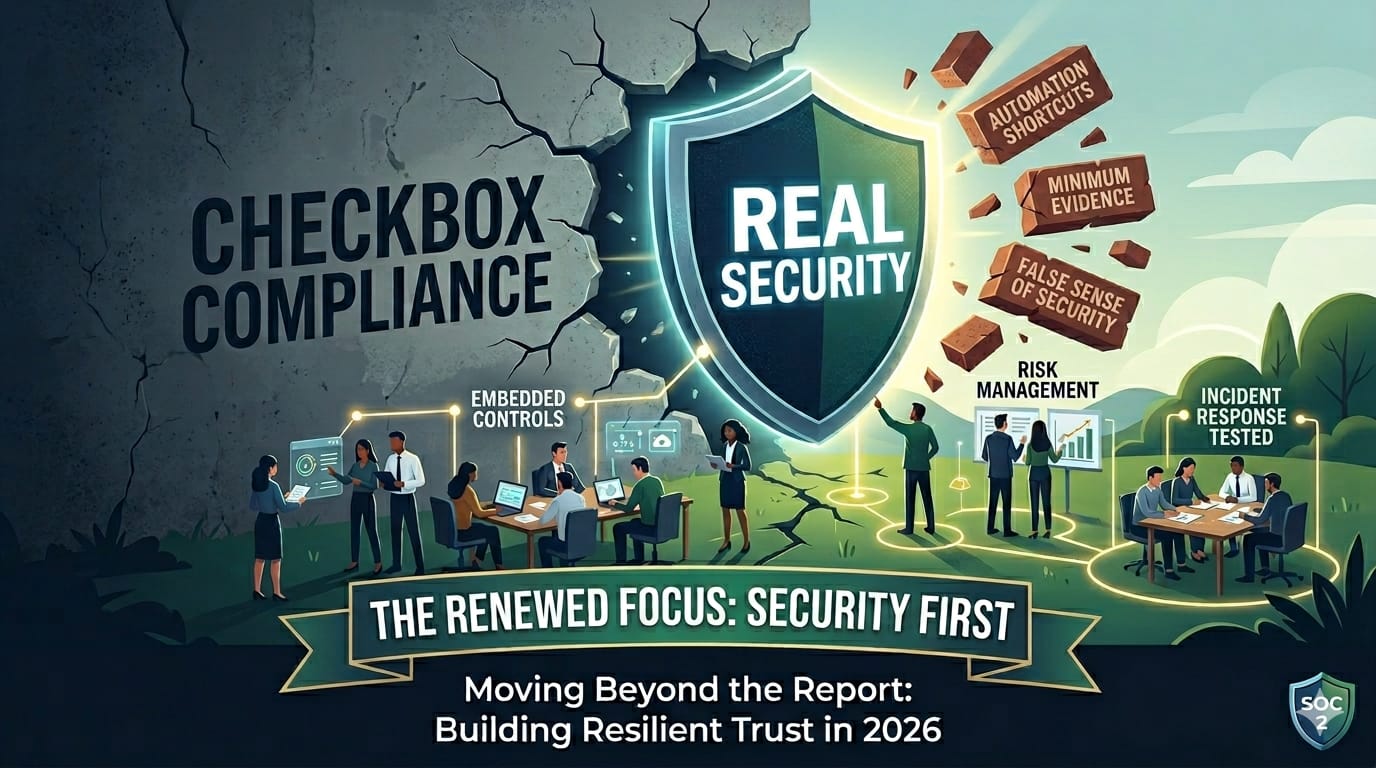
Most companies approaching SOC 2 for the first time make the same mistake. They treat it as a security project. It isn't. It's a documentation and process discipline project that happens to be about security. The difference matters more than it sounds. A company with genuinely strong security but no evidence trail will struggle in an audit. A company with average security controls that are consistently applied, clearly owned, and thoroughly documented will sail through. Auditors cannot test what they cannot see. They can only evaluate what you can prove. This is Auditify Security's practical roadmap to SOC 2 certification — structured around the actual sequence of work, written for teams that want clarity rather than theory.
Why SOC 2 Has Become the Baseline for Enterprise Trust in 2025
The enterprise security landscape has changed. Procurement teams at Fortune 500 companies, mid-market SaaS buyers, and regulated-industry customers now treat SOC 2 Type 2 certification as a minimum threshold — not a differentiator. The security questionnaire that used to arrive occasionally now arrives before the first sales call.
SOC 2 is the primary trust signal in North American B2B markets because it answers the question buyers care about most: can I trust this vendor with my data? Not theoretically. Demonstrably, with a third-party audited report that confirms controls were tested and found to be operating effectively.
Beyond customer trust, SOC 2 is increasingly connected to cyber insurance underwriting, vendor risk management programmes, and enterprise procurement requirements. Companies that achieve and maintain SOC 2 Type 2 close larger deals faster, reduce security questionnaire overhead, and build an internal security culture that scales.
First, an Honest Question: Is This the Right Time?
Before investing months of effort, be clear about why you're pursuing SOC 2.
The strongest signal is your sales pipeline. When enterprise prospects start sending you detailed security questionnaires — asking for penetration test results, access review evidence, and incident response documentation — SOC 2 is the cleanest answer. One report handles dozens of questionnaires. Without it, your sales team answers each one manually, inconsistently, and at the cost of deal velocity.
If you're primarily selling to small businesses, the demand may not justify the investment yet. If you're planning an enterprise push, start now — the audit clock doesn't begin until you do.
SOC 2 isn't the only path. ISO 27001 is the stronger choice for global markets and supports mutual recognition with SOC 2 in many frameworks. PCI DSS is mandatory for payment processing environments. HIPAA governs health data in the US. SOC 2 is specifically designed for the North American enterprise buyer relationship, which makes it the default for SaaS companies scaling upmarket.
Type 1 vs. Type 2: Understanding the Evidence Standard
Type 1 is a snapshot. Your auditor evaluates whether controls are designed correctly at a specific point in time. Think of it as an architectural review — the blueprints look right.
Type 2 is a film, not a photograph. Your auditor evaluates whether controls operated consistently and effectively across a defined observation period. The most common window is six months, though three and twelve months are both used depending on customer requirements and timeline.
The practical implication: for Type 1, you need controls in place. For Type 2, you need controls that have been running — with dated evidence showing each occurrence. A quarterly access review that ran once during a six-month window isn't quarterly. A vulnerability scan that ran on day one and day 180 with nothing in between fails the consistency test.
Type 1 first, then Type 2 is a common sequencing strategy — particularly for companies that need to show enterprise customers something tangible while the observation period accumulates. A clean Type 1 report communicates seriousness and forward momentum during a sales cycle.

The Cross-Functional Reality: Who Owns What
SOC 2 will touch more teams than your CISO or security lead expects. If those teams don't have explicit ownership and deadlines, the program stalls.
Engineering carries responsibility for secure software development lifecycle (SSDLC) practices — code review gates, deployment approvals, change management tickets, and system logging.
Infrastructure and IT own identity and access management (IAM), privileged access controls, endpoint detection and response (EDR), and device management.
HR owns onboarding and offboarding controls, acceptable use acknowledgements, and security awareness training completion records.
Legal contributes to vendor contracts and data processing agreements (DPAs).
GRC or Compliance coordinates risk assessment, evidence assembly, and all auditor communication.
The fastest SOC 2 engagements share one characteristic: a named owner on every control domain before readiness work begins. Not a team. A person, with a deadline.
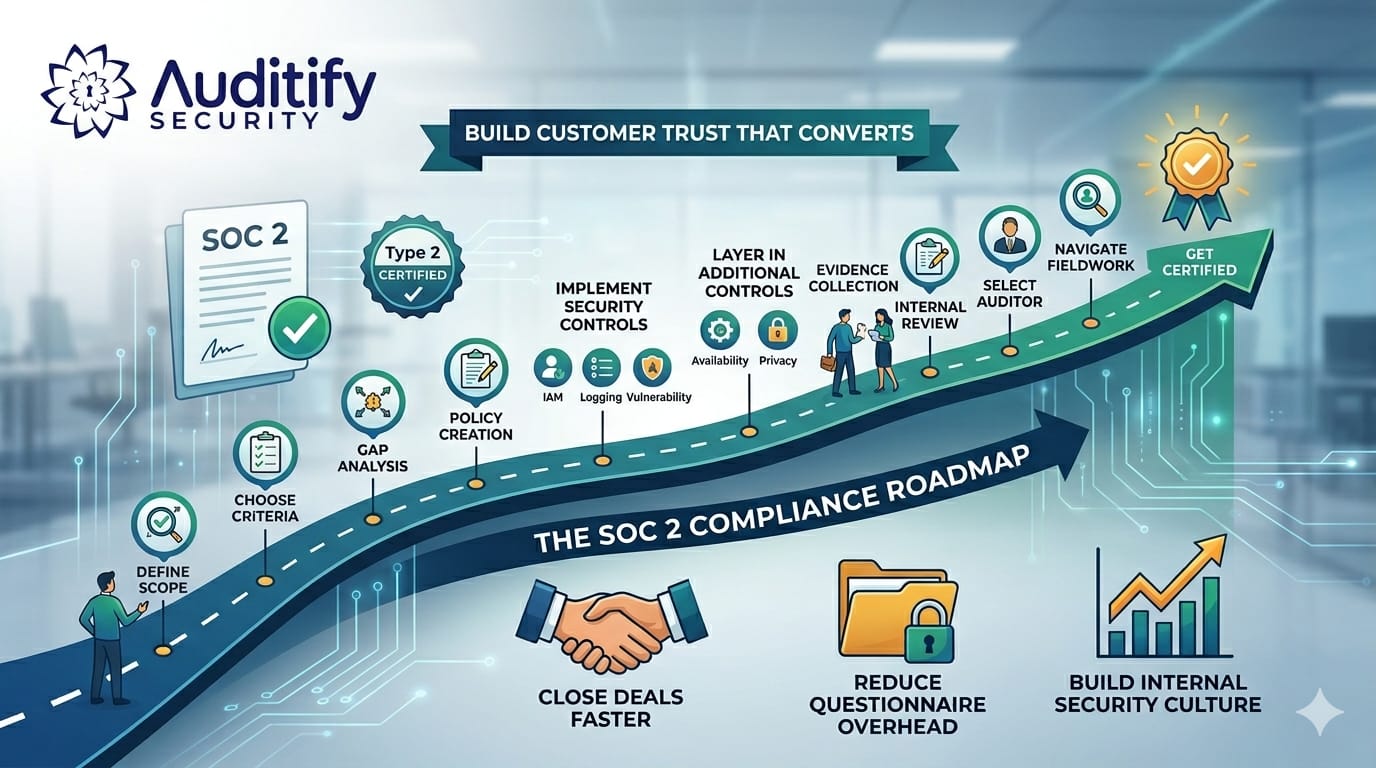
The 12-Step SOC 2 Certification Roadmap
1. Define Your Audit Scope — and Get It Signed Off Before Anything Else
Your audit scope is the single most consequential decision in the entire process. Draw it too wide and you multiply cost and effort without proportional benefit. Draw it too narrow and your auditor will flag the gaps while your customers ask why key systems aren't covered.
Scope has four dimensions. The service boundary covers what exactly you're providing to customers and which systems process or store their data. The infrastructure boundary covers which cloud environments, CI/CD pipelines, databases, and identity providers are in scope. The people boundary covers which employees and contractors have access to in-scope systems. The third-party boundary covers which vendors handle customer data on your behalf — and whether they're excluded from scope via their own SOC 2 reports (Carve-out method) or included directly in your audit (Inclusive method).
Data classification belongs here too. If your environment touches PII, PHI, or payment card data, that shapes both scope and criteria selection, and may implicate GDPR, CCPA, or HIPAA requirements alongside your SOC 2 obligations.
Get leadership sign-off on scope in writing before readiness work begins. Scope disputes mid-audit are expensive and avoidable.
2. Choose Your Trust Services Criteria Deliberately
Security criteria — formally called the Common Criteria — is included in every SOC 2 report. The other four criteria are decisions you make based on your service commitments and data obligations.
Availability is relevant if you've published uptime commitments or SLAs. Your customers are relying on your service to be running, and this criterion holds you accountable to the controls that support that promise — redundancy, disaster recovery, and incident management.
Confidentiality applies when you handle sensitive business information that isn't personal data — client contracts, proprietary pricing, or trade secrets. Common in B2B SaaS, legal tech, and financial services.
Processing Integrity is the right choice when the accuracy and completeness of your processing is the core of your product. Payroll platforms, billing engines, and financial data processors need this criterion to demonstrate that their systems do exactly what customers expect.
Privacy comes into scope when you collect and process personal information at scale — particularly where GDPR, CCPA, PIPEDA, or similar data protection regulations apply. The overlap between Privacy criteria and regulatory compliance is intentional and significant.

Every inclusion and every exclusion must be documented with a written rationale. Auditors review these explanations carefully. And remember: every criterion you include creates a control set you must maintain and evidence indefinitely.
3. Establish the Audit Timeline Before You Build Anything
The most common SOC 2 planning error is jumping into control implementation without first establishing the mechanics of the engagement.
Start with a formal readiness assessment or gap analysis. This is a structured review of your current control environment against the selected Trust Services Criteria. It surfaces what exists, what's missing, and critically — what exists in practice but has never been documented. Without it, you're building a remediation plan on assumption.
Once you understand the gaps, select your audit type and lock in the observation period start date. That date is consequential: it's when your evidence clock begins, and anything before it won't count for Type 2 purposes. Assign control owners with explicit deadlines and build an evidence calendar — a document that maps each control to the responsible person and the dates by which evidence must be collected and ready.
The most common audit delay isn't missing controls. It's evidence that arrives late, incomplete, or undated.
4. Select Your Auditor and Lock In the Engagement Terms
Your auditor must be a licensed CPA firm with formal SOC 2 examination authority under SSAE 18 and AT-C 205. Beyond the license, sector familiarity, communication style, and responsiveness matter more than brand recognition.
A firm that has audited SaaS companies at your growth stage will ask sharper questions, write a more accurate system description, and focus on issues that actually matter to your risk profile. Ask for references from clients of comparable size and complexity.
Before signing anything, clarify four things: how they test controls, what their sampling methodology looks like, how they characterize subservice organizations in the report, and what the Prepared by Client (PBC) evidence process looks like in practice. The engagement letter should make scope, observation period, and deliverables explicit. Ambiguity here becomes disputes during fieldwork.
5. Run an Honest Gap Analysis Against the Trust Services Criteria
A gap analysis is not optional pre-work. It is the foundation of your entire remediation plan and, done well, significantly reduces the risk of audit surprises.
Map every control you believe you have against the relevant criteria. Identify what's missing entirely, what exists in practice but has never been formalised, and what's inconsistently applied. Inconsistency is often harder to remediate than absence — you're changing operational behavior, not just creating a document.
Prioritize by risk exposure. A missing access review process for privileged accounts — directly relevant to zero trust security principles and least-privilege access — is a higher-priority remediation than an incomplete vendor questionnaire template. Document compensating controls where genuine gaps exist but full remediation isn't immediately feasible. Auditors can work with compensating controls, provided they're formally acknowledged and explicitly documented.
Be honest about what you find. Auditors encounter companies that have clearly tidied up surface-level evidence while ignoring systemic gaps. The result is audit exceptions — far worse for your enterprise sales process than taking a few extra months to remediate properly.
6. Build Policies That Reflect What Your Team Actually Does
Policies are the written commitment that your controls are real. An information security policy that describes processes your team doesn't follow is more dangerous than having no policy at all — it creates a documented, auditable gap between what you committed to and what you practiced.
The core policy set for SOC 2 includes information security, access control and identity management, change management, incident response, vendor risk management, and business continuity and disaster recovery (BCDR). If Privacy is in scope, add a privacy notice aligned to your actual data practices, data handling procedures, and a documented retention schedule.
Each policy needs a version number, a formal approval date, and evidence that employees have acknowledged it — typically through security awareness training completion records. Annual policy reviews are standard. Policies last updated three years ago that haven't been revisited will draw comment from your auditor.
7. Implement the Security Controls the Common Criteria Demands
This is where the majority of implementation work lives. The Common Criteria is the largest section of any SOC 2 report, covering identity management, monitoring, vulnerability management, encryption, secure development, change control, incident response, risk management, vendor oversight, and physical security.
Identity and access management (IAM): Multi-factor authentication (MFA), single sign-on (SSO), role-based access control (RBAC), and least-privilege enforcement must be the rule — not the exception. Privileged access must be specifically governed and reviewed on a defined cadence.
Logging and monitoring: Centralized logging with alerting thresholds and documented review processes. Security information and event management (SIEM) tools are common here, though the criterion is about the process, not the specific tooling.
Vulnerability management: Defined scan cadence, documented patch SLAs, and evidence that both happen on schedule. Penetration testing results and remediation tracking belong here too.
Encryption: In transit (TLS 1.2 minimum) and at rest across all in-scope data stores, with documented key management practices.
Secure SDLC: Code review gates, static application security testing (SAST), dependency scanning, and deployment approval workflows.
Risk assessment: Annual at minimum, producing a documented risk register with owner-assigned remediation plans that are actively tracked.
8. Layer In Controls for Additional Criteria in Scope
Work through each additional criterion methodically. Do not implement controls for criteria that aren't in scope — every control you add is a control you must evidence on an ongoing basis.
For Availability: Define uptime commitments formally. Configure monitoring with documented thresholds and escalation paths. Run a BCDR test — and document what failed, not just what worked. Auditors look specifically for evidence of improvement cycles, not just completion checkboxes.
For Confidentiality: Build a data classification schema. Enforce RBAC over classified data categories. Document disposal procedures — how data is securely deleted or destroyed at end of lifecycle. Validate encryption coverage.
For Processing Integrity: Document system processing controls and what prevents errors at each stage. Define input validation mechanisms. Monitor output accuracy. Track how customer-reported processing issues are recorded, escalated, and resolved — this is the operational evidence auditors test.
For Privacy: Publish a privacy notice that accurately reflects what you collect, how you use it, and how long you retain it. Build a functional Data Subject Access Request (DSAR) process — not just a policy, but an operational workflow with defined SLAs. Document your approach to cross-border data transfers, particularly relevant for GDPR-regulated environments.
9. Build Your Evidence Package with the Auditor's Workflow in Mind
Evidence is the product of your SOC 2 program. Everything else — policies, controls, training — exists to generate it.
The standard evidence package includes a system description (the narrative of your environment, services, and controls), control narratives for each domain, access review logs, change management tickets, incident records, vulnerability scan outputs, penetration test reports and remediation evidence, vendor SOC 2 reports for critical subservice organizations, security awareness training completion records, and BCDR test documentation with improvement tracking.
For Type 2, evidence must be distributed consistently across the observation period — not clustered at the beginning and end. A vulnerability scan on month one and month six with nothing documented in between does not demonstrate a quarterly cadence.
Organize your evidence around the auditor's workflow. Auditors map evidence to criteria. Label everything by control reference. Date everything. Ensure traceability to a specific system, process, or individual. If your package makes the mapping obvious, fieldwork is faster and generates fewer follow-up requests.
10. Run an Internal Review Before You Open the Door to Your Auditor
An internal control review before fieldwork is one of the highest-leverage activities in the entire process.
Have every control owner formally review and sign off on the evidence in their domain. Any exceptions — controls that didn't run as designed, evidence that's incomplete, or processes that were inconsistently applied — should be documented proactively with root cause analysis and corrective action plans. Presenting exceptions proactively demonstrates program maturity. Auditors discovering them independently does the opposite.
Run a management review. This is not a formality. It signals organizational accountability, creates a documented record of executive oversight, and gives leadership a genuine understanding of where the program stands. Auditors pay attention to whether management can speak to the program coherently — it's a signal of whether SOC 2 is a real initiative or a paper exercise.
11. Navigate the Audit Itself with Confidence
Audits move through three phases: walkthroughs, sampling, and reporting. Walkthroughs are your opportunity to provide context for how controls operate. Sampling is where evidence is formally tested. Reporting is where everything is summarized in the final report.
Designate a single point of contact who coordinates all evidence delivery and auditor communication. Respond to sampling requests immediately — delays extend the engagement and signal that evidence isn't readily available, which is exactly the impression you want to avoid.
When the draft report arrives, read it carefully. Check the scope language, the system description accuracy, the characterization of subservice organizations, and the wording of any noted exceptions. Inaccuracies in the draft are far easier to correct before the report is finalized and issued to customers.
12. Treat Certification as the Starting Point, Not the Finish Line
SOC 2 Type 2 certification is not a finish line. It is the beginning of an ongoing security compliance program. Companies that treat it as a one-time project find every renewal cycle harder than the last.
Continuous compliance means quarterly access reviews run on schedule, vulnerability scans happen with documented results, annual risk assessments produce updated risk registers, vendor risk management reviews occur when vendor relationships change, monitoring and alerting remain configured and reviewed, and policies are updated when your environment evolves.
Evidence collection should be systematic and ongoing — automated where possible, manually managed where necessary, but never left to a pre-audit scramble. Continuous control monitoring tools and GRC platforms exist specifically to reduce the manual overhead of evidence collection. The teams that find SOC 2 renewal straightforward embedded compliance into their operational cadence from the start, rather than treating it as a project with a completion date.
Frequently Asked Questions About SOC 2 Compliance
What is the difference between SOC 2 Type 1 and SOC 2 Type 2?
Type 1 evaluates whether controls are designed correctly at a point in time. Type 2 evaluates whether those controls operated consistently over a defined period, typically six months. Type 2 carries significantly more weight with enterprise buyers because it demonstrates operational discipline, not just design intent.
How long does SOC 2 certification take?
Type 1 can be completed in as little as six to eight weeks once controls are in place and evidence is ready. Type 2 depends on the observation period — a six-month window means the earliest possible Type 2 report is approximately eight to nine months from the program start, factoring in readiness, observation, fieldwork, and reporting.
What is the cost of SOC 2 compliance?
Audit fees vary by firm and scope, typically ranging from USD 15,000 to USD 50,000+ for the audit itself. Total program costs — including readiness work, tooling, remediation, and internal time — vary significantly based on your starting point. Companies with mature internal security practices spend less. Companies building from scratch spend more.
Which Trust Services Criteria should we include?
Start with Security, which is mandatory. Add Availability if you have uptime commitments. Add Confidentiality if you handle sensitive business data. Add Processing Integrity if accuracy of processing is central to your service. Add Privacy if you process personal data at scale. Every inclusion must be documented and defensible.
What is zero trust and how does it relate to SOC 2?
Zero trust is a security architecture principle — verify every user and device, never assume trust, enforce least-privilege access. It maps directly to the SOC 2 Common Criteria requirements for identity and access management, logical access controls, and network segmentation. Organizations implementing zero trust principles are generally better positioned for SOC 2 compliance from the start.
Does SOC 2 cover cloud security?
Yes. SOC 2 is cloud-agnostic and widely used by cloud-native companies. Cloud security controls — including infrastructure configuration management, cloud access security, and shared responsibility model documentation — fall within the Common Criteria scope. AWS, Azure, and GCP each provide their own SOC 2 reports that can be used as evidence for your subservice organization controls.
What happens if we fail the SOC 2 audit?
SOC 2 audits don't have a binary pass/fail outcome. Reports can be issued with exceptions noted — controls that were not found to be operating effectively. Exceptions don't automatically disqualify a report, but they require disclosure to customers and can affect deal outcomes. Most exceptions are avoidable with thorough readiness work and honest internal reviews before fieldwork begins.
Start Your SOC 2 Journey with Auditify Security
Getting to SOC 2 certification doesn't have to mean months of uncertainty, spreadsheet-based evidence tracking, and last-minute audit scrambles. At Auditify Security, we've built a structured readiness program that takes companies from initial scoping to audit-ready in as little as six weeks — combining hands-on practitioner expertise with the automation tools that make ongoing compliance manageable.
Whether you need a gap assessment to understand where you stand, a complete readiness and Type 1 engagement, a full Type 2 program, or a compliance partner for continuous monitoring after certification — we work alongside your team at every stage.
Book a free SOC 2 readiness consultation in our Calendar.
Auditify Security provides SOC 2 readiness, audit support, and continuous compliance services alongside ISO 27001, HIPAA, GDPR and VAPT. We work with SaaS companies, cloud-native teams, and technology businesses across North America and globally.