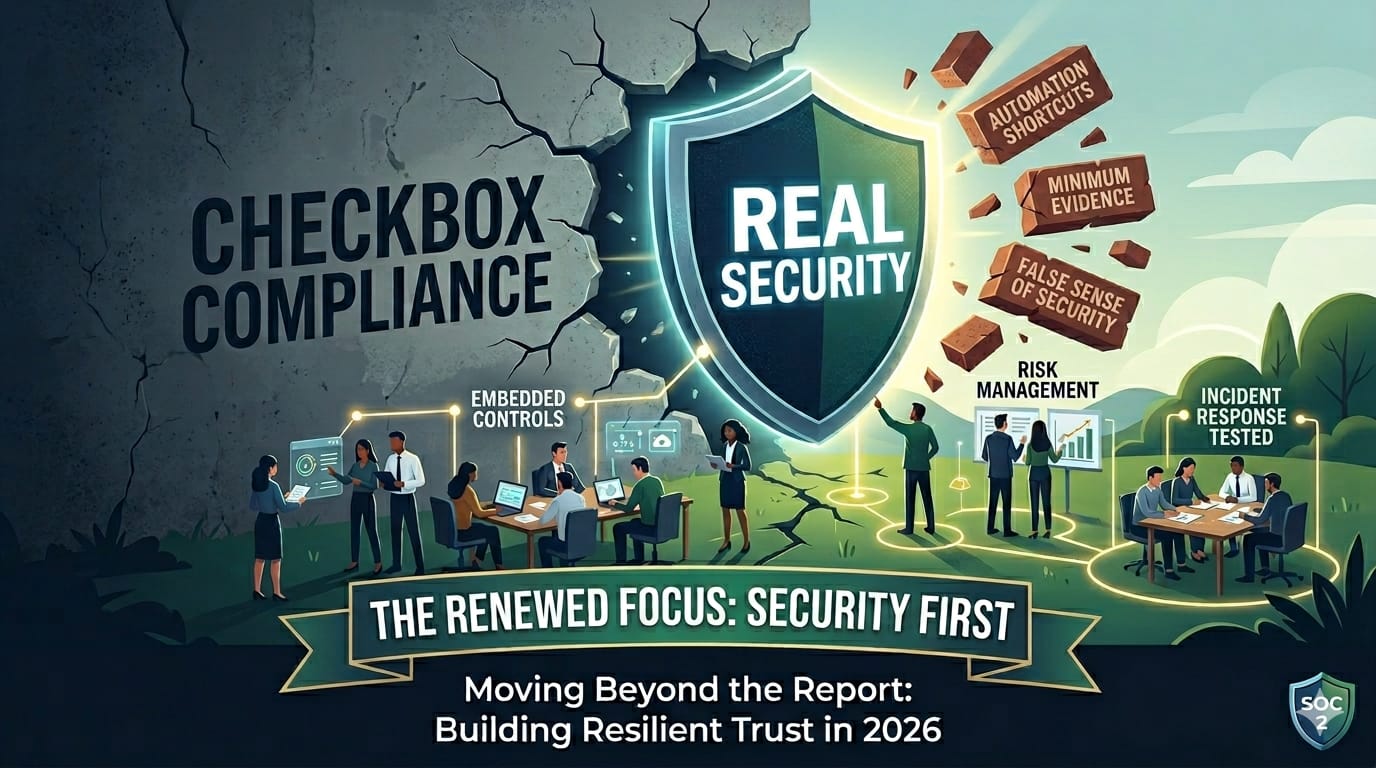
SOC 2 isn't going away, but passing it is getting harder. Evidence quality, incident response testing, vendor risk management, and auditor scrutiny are all tightening simultaneously. Here's what that means for startups and SMBs who built their compliance programs around the audit, not around security.
SOC 2 has become one of the most purchased, most misunderstood, and most misused compliance frameworks in the history of information security.
And in 2026, that's finally starting to catch up with everyone.
Let me be direct.
A significant portion of SOC 2 reports in circulation right now were not earned. They were manufactured. Packaged. Delivered on a timeline that prioritized the sale over the security program.
I'm not talking about fraud. I'm talking about something more subtle, and more dangerous.
I'm talking about the industrialization of compliance.
Here's what actually happened.
SOC 2 exploded in demand around 2018–2020. Enterprise buyers started requiring it. Investors started asking for it. Sales teams started losing deals without it.
So a market emerged to meet that demand.
Compliance automation platforms. Audit-ready templates. "Get your SOC 2 in 90 days" packages. Managed audit services bundled with the software that monitors your controls.
On the surface, this looked like innovation. Democratizing compliance for startups and SMBs that couldn't afford a Big 4 engagement.
And in some ways, it was.
But it also quietly lowered the bar. Dramatically.
Here's what that created.
Companies with SOC 2 Type II reports that can't explain their own access review process.
Security programs built backwards, starting with the audit criteria and working backwards to collect just enough evidence to satisfy each control.
Auditors who are incentivized to complete engagements efficiently, not rigorously.
Automation platforms that generate evidence automatically, screenshots, logs, policy acknowledgments, with minimal human understanding of what's actually being controlled.
And boardrooms full of executives who think they're secure because they have a clean SOC 2 report sitting in their data room.
This is the quiet crisis in compliance. And it's been building for years.
Now the environment is shifting. And it's going to be painful.
Several things are converging right now that will fundamentally change what SOC 2 means in practice:
1. Auditor scrutiny is increasing.
The AICPA has been clear, the 2017 Trust Services Criteria were designed to be principles-based, not checkbox-based. Auditors who've been letting weak evidence slide are starting to face more scrutiny themselves. Expect audit firms to tighten standards across the board, especially as high-profile breaches keep hitting companies that had clean compliance reports.
2. Enterprise security questionnaires are getting harder.
Your SOC 2 report used to answer the question. Now procurement teams are reading the report AND sending a 200-question security questionnaire on top of it. Why? Because they've been burned. A report that says "access is reviewed quarterly" doesn't tell them whether that review actually caught anything. Buyers are digging deeper. Your report is now the beginning of the conversation, not the end.
3. The AICPA's additional subject matter guidance is expanding.
New supplemental criteria around cybersecurity risk management and privacy are creating pressure on what a "complete" SOC 2 program looks like. Companies that have been operating lean, covering only the Security TSC with minimal additional criteria, are going to feel the gap widen.
4. Incident response is becoming a critical test.
It's no longer enough to have an IR policy on paper. Auditors and customers alike are starting to ask: have you tested it? Tabletop exercises, documented lessons learned, evidence of real-world response, these are becoming part of the expectation, not optional extras.
5. Subservice organization scrutiny is intensifying.
If your SOC 2 relies on carve-outs for AWS, your CRM, or your payroll provider, buyers are starting to ask hard questions about your vendor risk management program. "We use AWS" is not a risk management strategy. How are you monitoring those relationships? What's your exposure if a subservice organization fails?
Here's what concerns me most.
The companies most at risk aren't the ones ignoring compliance.
They're the ones who checked the box, got the report, and stopped thinking about security.
They believe they're protected. They've told their board they're protected. They've told their customers they're protected.
And then something breaks. An access control that looked good on paper wasn't actually enforced. A vendor with broad data access went unreviewed for 18 months. An employee offboarding slipped through the cracks because the process existed in a document but not in practice.
The SOC 2 report didn't lie. But it also didn't tell the whole truth.
That's the real danger of checkbox compliance, it creates a false ceiling. Once you have the report, the pressure to keep building the security program disappears. The audit is done. Move on.
What does good actually look like?
A real SOC 2 program isn't built for the auditor. It's built for the business.
It means your controls are operating because they're embedded in how your team actually works — not because someone scrambled to generate evidence two weeks before the audit window.
It means your access reviews are happening because you have a quarterly rhythm, not because your compliance platform auto-generated a screenshot.
It means your security policies are read, understood, and followed, not acknowledged once a year in a DocuSign envelope nobody opens.
It means when something goes wrong, and something will go wrong, your team knows exactly what to do, who to call, and how to contain it.
That's what auditors should be testing for. That's what enterprise buyers should be asking for. And that's what security leaders should be building toward.
The SOC 2 industry is about to go through a correction.
The easy button is breaking.
The companies that built their compliance programs on automation shortcuts and minimum viable evidence are going to start feeling the pressure, from auditors, from customers, from regulators, and eventually from incidents that their report said couldn't happen.
The companies that built real security programs, and used SOC 2 as a way to validate them, are going to pull further ahead.
This isn't a criticism of the framework. SOC 2 is still one of the most practical, flexible, and meaningful trust signals available to growing companies.
But it's only meaningful if it means something.
Right now, for too many organizations, it doesn't.
That needs to change. And in 2026, I think it finally will.
Start Your SOC 2 Journey with Auditify Security
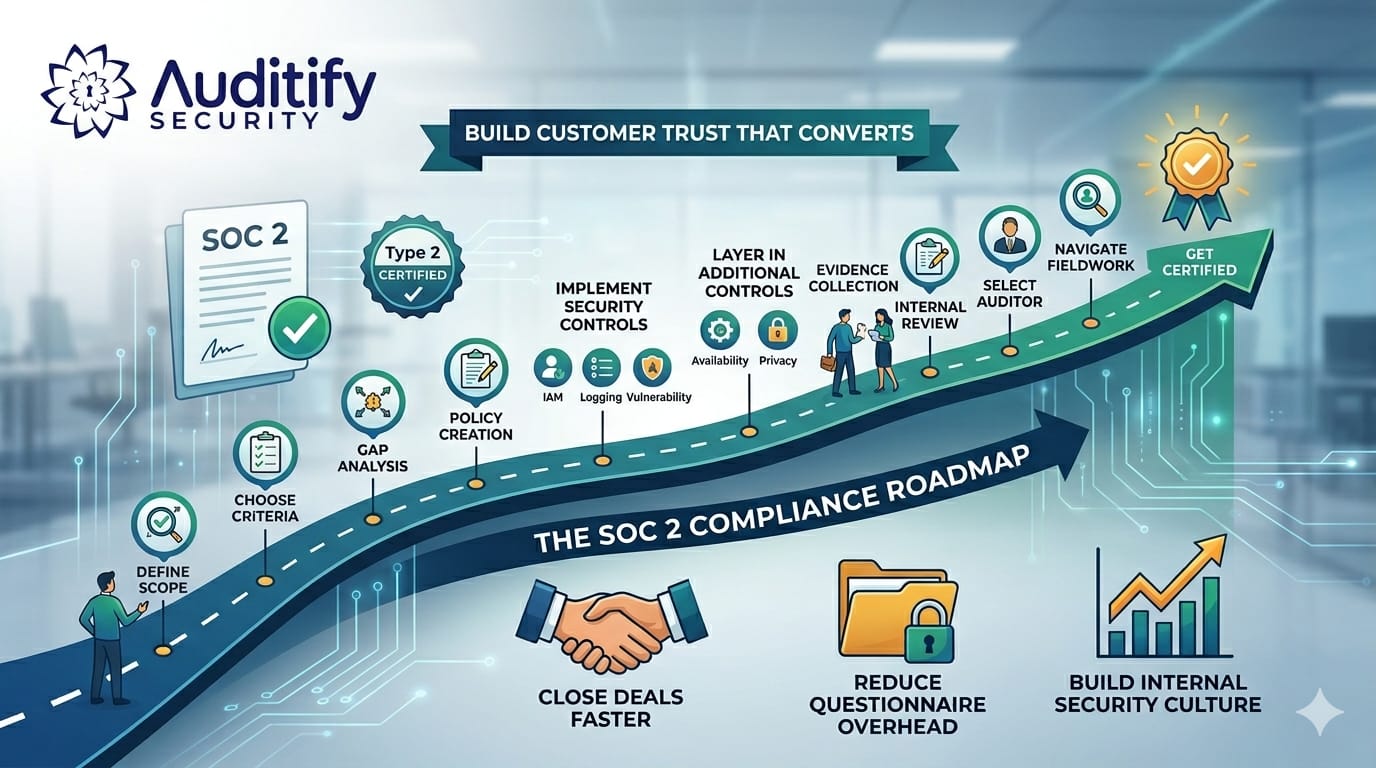
Getting to SOC 2 certification doesn't have to mean months of uncertainty, spreadsheet-based evidence tracking, and last-minute audit scrambles. At Auditify Security, we've built a structured readiness program that takes companies from initial scoping to audit-ready in as little as six weeks — combining hands-on practitioner expertise with the automation tools that make ongoing compliance manageable.
Whether you need a gap assessment to understand where you stand, a complete readiness and Type 1 engagement, a full Type 2 program, or a compliance partner for continuous monitoring after certification — we work alongside your team at every stage.
Book a free SOC 2 readiness consultation in our Calendar.
Auditify Security provides SOC 2 readiness, audit support, and continuous compliance services alongside ISO 27001, HIPAA, GDPR and VAPT. We work with SaaS companies, cloud-native teams, and technology businesses across North America and globally.