Get your organization audit-ready with confidence! This guide by Auditify Security breaks down the complete roadmap to SOC 2 readiness — from governance and risk management to access controls, incident response, and continuous monitoring — helping you achieve first-time compliance success.
Preparing for your first SOC 2 audit can feel daunting — but it doesn’t have to be.
At Auditify Security, we believe SOC 2 readiness isn’t just about passing an audit; it’s about building a sustainable and scalable security culture that earns client trust and strengthens your brand reputation.
SOC 2 compliance proves your organization’s commitment to protecting customer data according to the Trust Services Criteria — security, availability, processing integrity, confidentiality, and privacy. Based on years of experience helping businesses achieve first-time success, here’s the ultimate roadmap to get audit-ready with confidence.
1. Establish Strong Governance & Leadership
A mature SOC 2 program starts with effective governance.
Board Oversight: Maintain a documented charter, annual board minutes, and a clear security oversight framework.
Defined Roles & Responsibilities: Assign accountable owners for security, compliance, and risk management.
Tone at the Top: Leadership should actively promote a security-first culture.
2. Build Living, Breathing Security Policies
Outdated or static policies are red flags for auditors.
Annual Reviews: Regularly review and reapprove all policies or when major changes occur.
Real-World Alignment: Ensure policies accurately reflect your people, processes, and technologies.
Accessibility: Store and communicate policies in a shared, version-controlled system.
3. Strengthen Personnel Controls
Your employees are your first line of defense.
Onboarding & Offboarding: Manage user access provisioning and timely terminations.
Security Awareness Training: Conduct regular training and keep attendance records.
Policy Acknowledgements: Track signed acknowledgements for confidentiality and ethical conduct.
4. Implement a Robust Risk Management Program
SOC 2 auditors expect a proactive risk management approach.
Risk Identification & Assessment: Evaluate internal and vendor risks periodically.
Remediation Plans: Assign owners, deadlines, and monitor progress.
Central Risk Register: Maintain and update regularly for audit evidence.
5. Manage Vendor Risks Effectively
Your third-party vendors extend your security perimeter.
Vendor Evaluation: Conduct due diligence before onboarding.
Vendor Inventory: Track all providers, services, and risk classifications.
Compliance Reports: Collect annual SOC 2 or ISO 27001 reports.
Contract Documentation: Maintain up-to-date NDAs, MSAs, and BAAs.
6. Enforce Authentication & Access Controls
Access management directly impacts SOC 2 compliance.
MFA & SSO: Enforce for all users, especially privileged accounts.
Role-Based Access: Map access levels to job functions.
Access Reviews: Perform quarterly reviews and segregate duties appropriately.
7. Secure Cryptographic Key Management
Data encryption is only as secure as your key management.
Key Lifecycle: Control key generation, storage, distribution, and rotation.
Logging & Monitoring: Maintain detailed logs for key access and updates.
8. Strengthen Endpoint Security
Every device is a potential attack surface.
MDM Enforcement: Manage both company-owned and BYOD assets.
Continuous Monitoring: Verify endpoint compliance for:
Antivirus/Antimalware
Disk Encryption
Screen Lock Policies
OS Patching & Auto-Updates
9. Monitor Cloud Infrastructure
Cloud environments require complete visibility and control.
Coverage: Include compute, storage, databases, and networking layers (e.g., AWS, Azure, GCP).
IAM & RBAC: Regularly review cloud access roles.
Log Management: Use tools like Datadog, CloudWatch, or Wazuh for visibility.
Security Alerts: Deploy IDS/IPS and define escalation protocols.
10. Maintain Rhythm Controls & Continuous Monitoring
SOC 2 maturity is proven by consistency.
Recurring Activities: Access reviews, vulnerability scans, firewall audits, and tabletop exercises.
System Monitoring: Backup validation, redundancy testing, and log retention.
Cyber Insurance: Maintain annual coverage and evidence.
11. Conduct Vulnerability Management & Penetration Testing
Proactive testing minimizes audit findings.
Regular VAPT: Perform internal and external tests at least twice a year.
Remediation SLAs: Address critical vulnerabilities promptly.
Documentation: Keep test results, tickets, and remediation evidence organized.
12. Strengthen Change Management
Controlled change reduces security risks.
Change Requests: Record all changes with approvals and testing evidence.
Code & Infrastructure Tracking: Enforce segregation of duties and maintain audit logs.
Version Control: Ensure traceability for every deployment.
13. Ensure Physical & Environmental Security
Even cloud-first companies need physical safeguards.
Office Security:
CCTV surveillance and visitor logging
Biometric or badge-based access
Fire safety, HVAC, and backup power checks
Data Center Security:
Review SOC 2/ISO 27001 reports annually
Fire suppression, redundant power, and cooling systems
14. Prepare an Incident Response Plan
Incidents are inevitable — preparedness is key.
Incident Logging: Capture severity, root cause, and corrective actions.
Stakeholder Notifications: Document communication with affected parties and regulators.
Post-Incident Reviews: Implement learnings for continuous improvement.
15. Manage IT Assets and Secure Disposal
Every asset should have a lifecycle plan.
Inventory Management: Maintain an updated asset register with ownership details.
Secure Disposal: Use certified destruction vendors and retain certificates.
Final Thoughts: SOC 2 Readiness Is a Continuous Journey
Achieving SOC 2 compliance is more than a milestone — it’s the foundation of a trustworthy security posture. Whether you use a GRC tool or manage manually, readiness becomes manageable with the right expertise.
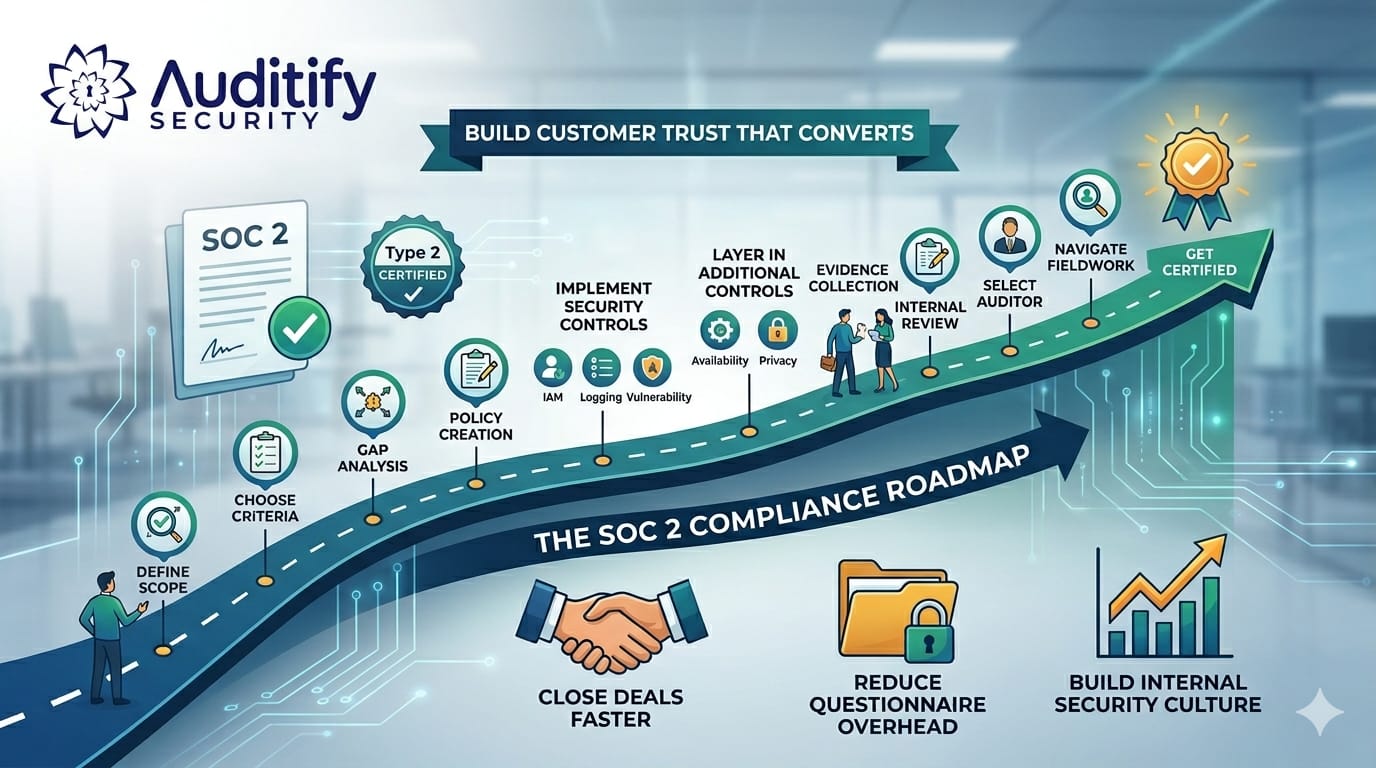
At Auditify Security, we simplify SOC 2 readiness — from policy creation and control design to evidence gathering and auditor coordination.
We don’t just help you pass the audit; we help you build a security framework that scales with your business.